
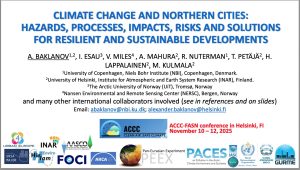
The presentation on “Climate Change and Northern Cities: Hazards, Processes, Impacts, Risks and Solutions for Resilient and Sustainable Developments” was delivered during the Atmosphere and Climate Competence Centre (ACCC) & Finnish Atmospheric Science Network (FASN) Science Conference held at the premises of the University of Helsinki and the Finnish Meteorological Institute during 10-12 November 2025 (Helsinki, Finland).
The main motivations for this study and overview assessments are the following:
- IPCC SR Climate Change and Cities needs to analyse solutions for cities of different types and regions;
- WMO Guidance for Integrated Urban Climate and Environmental Services did not included any demonstration city in Arctic or in high latitudes (HL);
- Lack of peer-reviewed publications especially systematic review and analysis for Arctic and HL cities;
- Arctic and HL cities are much more vulnerable to climate change and extreme events;
- There is an opinion and expectation that global warming is positive for northern cities and does not pose a risk. Unfortunately, this is far from true and requires careful analysis;
- There were several attempts to study some separate aspects of the problem, but a complex multidisciplinary analysis is needed.
Northern cities face distinctive climate risks shaped by geography and urban form. Coastal cities (e.g., Oslo, Reykjavik, Murmansk) grapple with sea-level rise and storm surge; permafrost cities (e.g., Yakutsk, Inuvik, Norilsk) face destabilization of foundations and infrastructure; pluvial flood-prone cities (e.g., Copenhagen, Helsinki, Stockholm) experience more intense rainfall. Across all, air pollution, heat waves, urban heat islands, and compounding hazards are emerging concerns.
This presentation analysed specific processes of climate change impact on cold cities, synthesizes risks, leading strategies, and proposes possible solutions for their climate smart, resilient and sustainable developments. Study methods include a systematic review and analysis of existing publications and projects, in-situ observations and remote sensing analysis, multi-scale integrated modelling and system analysis.
There is still a strong knowledge gap in understanding some specific problems of climate change consequences for northern cities including mitigations and adaptation to climate change and strategy for their climate-smart, resilient and sustainable development. Therefore, the authors invite interested scientists to focus on these issues and write scientific papers for several journal special issues in support of the IPCC SR Climate Change and Cities (see info in the presentation).
See more details in the presentation.
Text by: Alexander Baklanov, Niels Bohr Institute (NBI), University of Copenhagen, Denmark, & Institute for Atmospheric & Earth System Research (INAR), University of Helsinki, Finland