
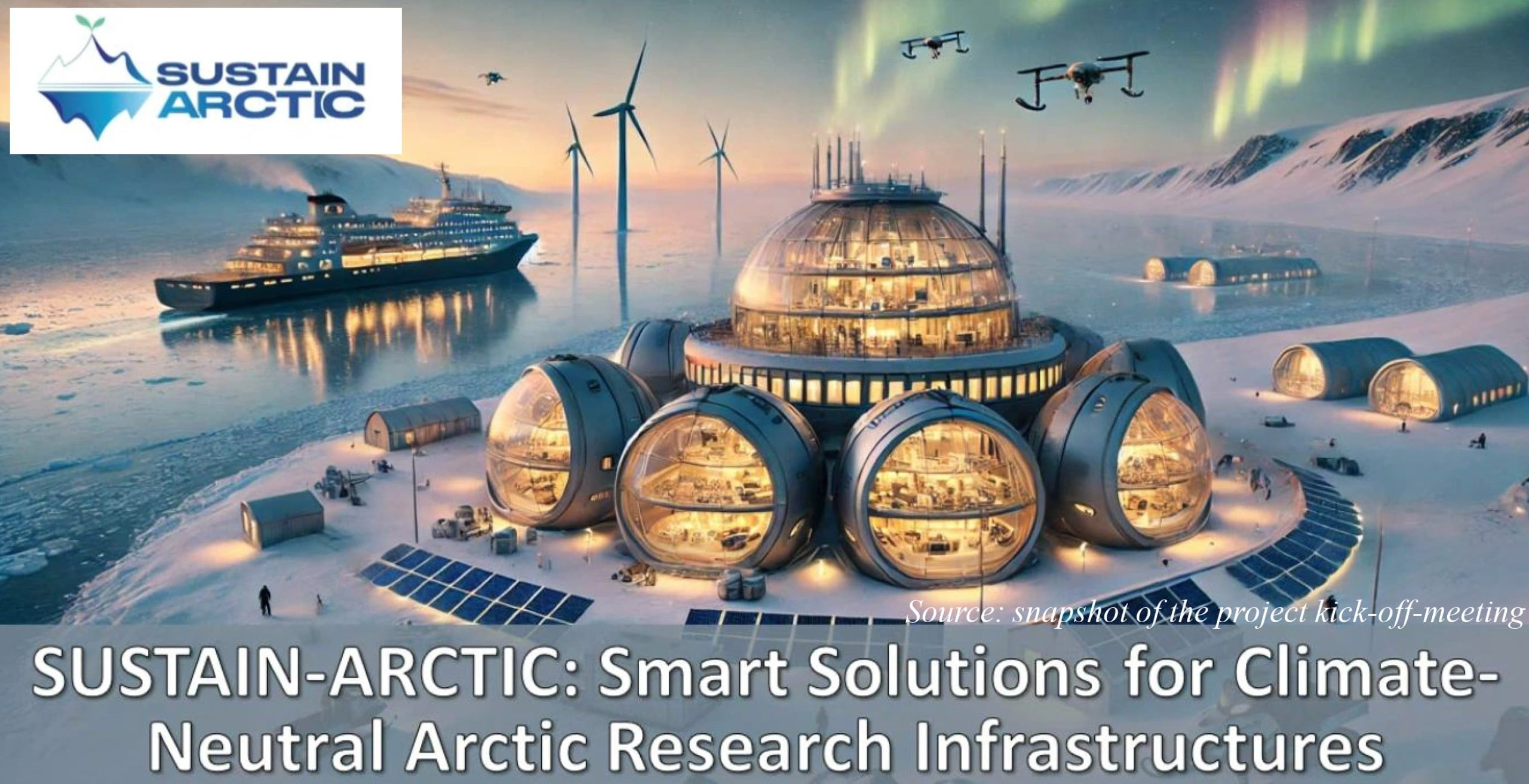
The Smart Solutions for Climate-Neutral Arctic Research Infrastructures (SUSTAIN-ARCTIC; 1 Oct 2026 – 30 Sep 2029) EU funded project kick-off-meeting took place in a hybrid mode during 12-13 October 2026 in Torino, Italy. It was hosted by the Polytechnic University of Turin (Politecnico di Torino; POLITO; https://www.polito.it/en), the coordinator of the project. More than 40 participants attended onsite and online.
The SUSTAIN-ARCTIC overarching aims to reduce environmental impact of Research Infrastructures (RIs), optimizing resource and energy consumption through their full life cycle. The SUSTAIN-ARCTIC specific objectives: (1) Develop technical solutions to reduce the climate and environmental impact of scientific research stations in the Arctic and sub-Arctic regions; (2) Develop and explore technical solutions and methodologies to reduce the footprint of field activities, also offering the capability to integrate more observations and increase their value; (3) Explore the potential of digital solutions as well as better integration of ground-based, unmanned and satellite observing systems; (4) Evaluate the potential of solutions and methodologies with respect to environmental impact reduction and resources optimization; (5) Promote implementation of new solutions and best practices in Environmental RIs community; and (6) Promote societal engagement to foster acceptance of the solutions in the local and regional communities as well as other stakeholder categories. The SUSTAIN-ARCTIC consortium includes 11 Partners – National Research Council of Italy (CNR, Italy), Norwegian University of Science and Technology (NTNU, Norway), University of Aarhus (AU, Denmark), Norwegian Research Centre (NORGE, Norway), Institute of Geophysics of the Polish Academy of Science (IGF, Poland), Natural Resources Institute Finland (Luke, Finland), University of Helsinki (UHEL, Finland) including three RIs: Svalbard Integrated Arctic Earth Observing System (SIOS, Norway), Analysis and Experimentation on Ecosystems (ANAEE ERIC, France), and Aerosol, Clouds, and Trace Gases Research Infrastructure (ACTRIS ERIC, Finland).
On 12th October, the meeting was open with welcome from the organizers and POLITO, and followed by sessions. The 1st session “Project scopes and workplan” started from introduction of the Politecnico di Torino University as the host. Then, the SUSTAIN-ARCTIC project was introduced by the coordinator Prof. Massimo Santarelli (POLITO), followed by presentations of Work Packages (WPs) by the WP leaders: WP1: Design, develop sustainable solutions for Arctic Research Infrastructures (RIs); WP2: Implementation, demonstration and validation of sustainable solutions for Arctic RIs; WP3: Design, develop solutions to Make greener the fieldwork; WP4: Implementation, demonstration and validation of solutions to make greener fieldwork; WP5: Develop digital solutions/ infrastructures; WP6: Quantify current impact and increase connection with society; WP7/8: Project management and dissemination activities for the first and second reporting periods. The 2nd session “Management and strategy for a strong project impact” included presentations about general indications from the Project Officer of the SUSTAIN-ARCTIC Dr. Pierre Quertenmont, EU Commission); The goodness and challenges of the lump sum model; Which strategy for the impact of the SUSTAIN-ARCTIC project; and followed by common discussion on the impact strategy. The 3rd session “The Research Infrastructures” included presentations about existing RIs such as Stanislaw Siedlecki Polish Polar Station in Hornsund (Polish operated; Svalbard, Spitsbergen), Ruukki station (Finnish; Northern Finland), GIOS Greenland Gradient Network (Danish; Greenland), Wet Snow Lab (Norwegian; Svalbard, Spitsbergen), and Kluane Lake research station (Canadian; Yukon, Canada). The 4th session “Deepen workplan for smart solutions in the Arctic RIs” included presentations and discussions about developing solutions for Hornsund with evaluating potential of green hydrogen solutions; improving wastewater management in Ruukki and other stations; best practices and sustainable solutions catalogue; solutions for onsite waste plastic handling; and wrap up at the end of the day.
On 13th October, on the morning, the meeting continued with several extra sessions – ”Deepen workplan to make greener the fieldwork”, “Deepen workplan for digital solutions”, “Connect with research community and society” – with presentations and discussions organized by the project Partners, and followed by final wrap-up and conclusions. In the second part of the day, the onsite participants attended the Conference on “Smart Solutions for a More Sustainable Arctic Research and Society” also hosted by the Politecnico di Torino. After the Politecnico di Torino greetings, the presentation by Dr. Agostino Pinna on “Italy and the Arctic following the adoption of the national strategy” was delivered, and followed by the introduction of the SUSTAIN-ARCTIC project partners, and presentations on Sustainability in the Arctic, How local communities and companies are experiencing a changing Arctic, The inuit Windsled project in Greenland, The Kluane Lake research station (Yukon, Canada); Transitioning to a greener future; Arctic Research in POLITO and University of Turin; ICEtoFLUX: geophysical and hydrogeological investigation of the Arctic environment (Ny-Ålesund, Svalbard); MOHYCAM: geospatial reference framework for high-altitude glacier monitoring in harsh environments; Cryosphere engineering; Applying the DPSIR framework within the H2020 ArcticHubs project: opportunities and challenges for the Arctic and Alpine regions; and Italian scientific research at the poles over the last 50 years.
Text by: Tuukka Petäjä, Alexander Mahura, UHEL-INAR