
2026 Session: Climate Change, Cities and Anthropogenic Impacts.
The PEEX team actively participated in the 2026 International Summer School Program on Climate Change and Related Risks <https://iss-climatechange.fudan.edu.cn/Description_of_2026_Session.htm> that was held at Fudan University’s Jiangwan campus from July 6 to July 24, focusing on Climate Change, Cities and Anthropogenic Impacts (see: Recap Video of the 2026 Session-International Summer School Program on Climate Change and Related Risks).
Cities, as highly complex socio-ecological systems, represent both hotspots of anthropogenic activities and frontlines of climate change impacts. They concentrate population, infrastructure, and economic activities, making them particularly vulnerable to the combined pressures of climate change and air pollution. At the same time, cities are major contributors to greenhouse gas emissions and resource consumption, playing a decisive role in shaping global environmental change. As extreme weather events become more frequent and compound and cascading risks increasingly evident, urban areas are emerging as critical arenas where climate, environmental, and ecological challenges intersect and amplify. Understanding the dynamic interactions between climate change, urban systems, and anthropogenic influences is therefore essential for advancing climate governance, enhancing urban resilience, and achieving sustainable development.
The 2026 session was organized by Fudan University’s Department of Atmospheric and Oceanic Sciences (AOS), the Institute of Atmospheric Sciences (IAS), the World Meteorological Organization Global Atmosphere Watch (WMO/GAW) and World Weather Research Programmes (WMO/WWRP), the MAP-AQ Asian Office Shanghai and the IRDR International Centre of Excellence on Risk Interconnectivity and Governance on Weather/Climate Extremes Impact and Public Health (ICoE-RIG-WECEIPHE).
Four modules of the School lectures were structured: (a) Climate change and urban climate effects, (b) Extreme weather events and their impacts, (c) Atmospheric environment and eco-health impacts, (d) AI-enabled sustainable development and climate resilience. Several internationally renowned scholars at the forefront of their fields and with extensive teaching experience were invited to lecture at the summer school. See Expert Profiles-International Summer School Program on Climate Change and Related Risks <https://iss-climatechange.fudan.edu.cn/Expert_Profiles.htm>.
The summer school selected and invited about 90 students, postdocs and early-career young professionals from applicants worldwide. Alongside lectures, interactive discussions and group mini-project assignments were organized to foster networking among participants. Prof. Alexander Baklanov was a lector for the module (a) Climate change and urban climate effects providing 6 lectures for the School participants and together with Dr. Alexander Mahura (INAR Helsinki University) and Dr. George Nerobelov (Max Planck Institute for Biogeochemistry) organized the EnviroHIRLAM exercise and Mini-project for school participants (also Dr. Roman Nuterman, NBI University of Copenhagen, was one of the authors of this exercise). See the Mini-project presentation title pages below.
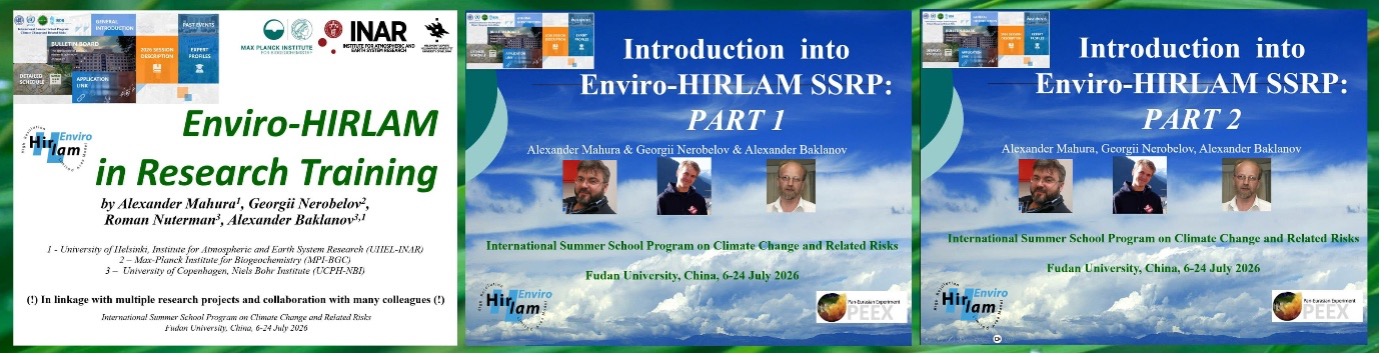
Additionally, participants had the opportunity to share their own research during the Talk & Connect Session through oral or poster presentation. Distinguished groups received cash awards for their outstanding performance on mini-project assignments. See more on Announcement of Mini-project Awards in the 2026 Session-International Summer School Program on Climate Change and Related Risks.
We are happy to report that our EnviroHIRLAM Mini-project “The Influence of Urban Areas on Meteorology” team “MetroClimate Lab” have received the 3rd Award! The Team included students from 4 different countries and 5 universities (see photo below).
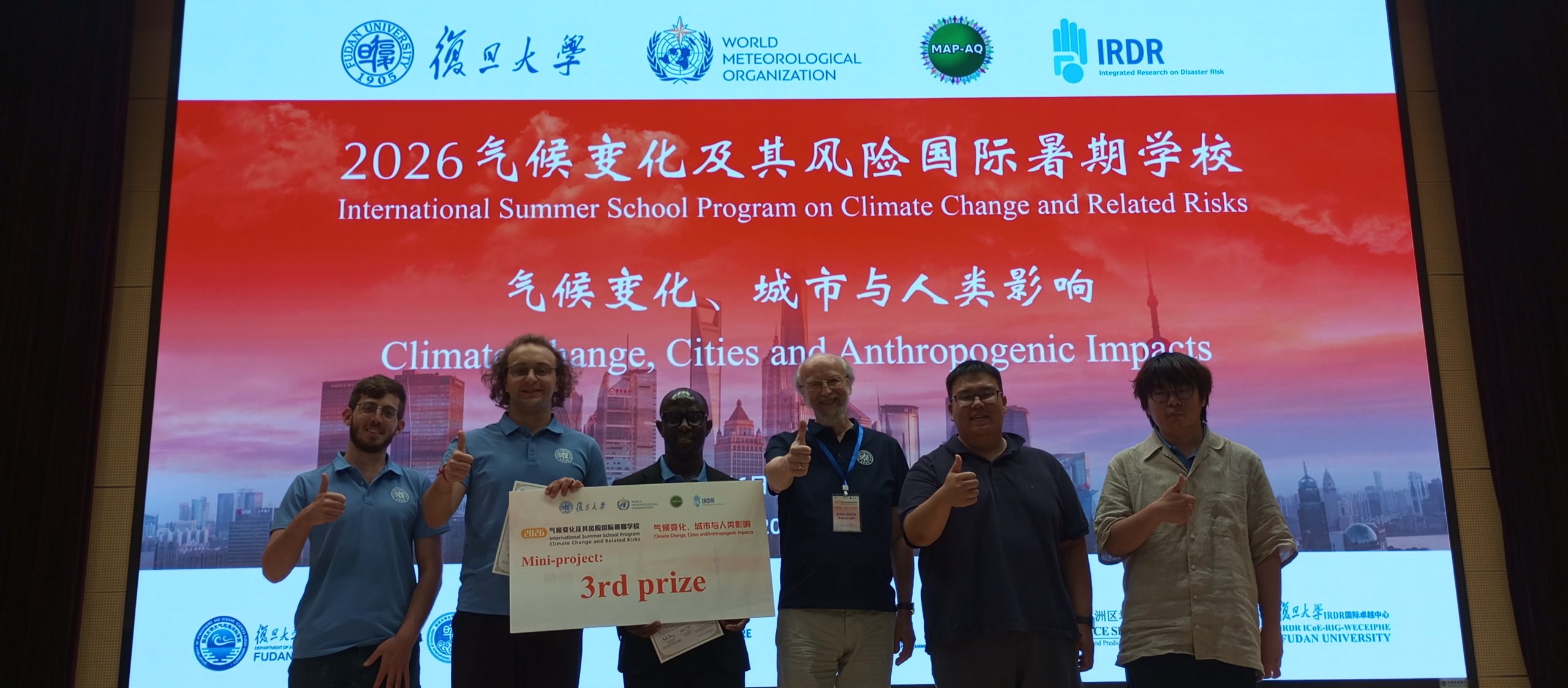
Our congratulations with this Award to the “MetroClimate Lab” Group members: DONG Hongmai (Fudan University), HE Bohan (Capital Normal University, Peking University), CHERKASHIN Daniil (Russian State Hydrometeorological University), JOBE Lamin (Department of Water Resources, Gambia), VAKRAT Eylon (University of Toronto), as well as the Mini-project supervisors: Drs. Alexander Mahura, George Nerobelov and Roman Nuterman.
Text by Prof. Alexander Baklanov, NBI – University of Copenhagen, Denmark / INAR – University of Helsinki, Finland