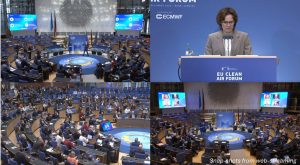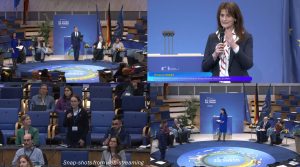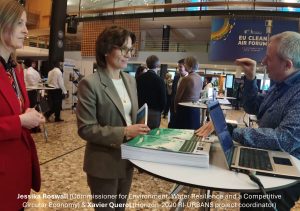
The 5th EU Clean Air Forum took place (in a hybrid mode) during 1-2 December 2025 in Bonn, Germany. This event was hosted by the European Centre for Medium-Range Weather Forecasts (ECMWF). The recently completed Horizon-2020 RI-URBANS project “Research Infrastructures Services Reinforcing Air Quality Monitoring Capacities in European Urban & Industrial AreaS” (1 Oct 2021 – 30 Sep 2025; https://riurbans.eu) was presented on this event.
This event was dedicated to the “EU clean air policy which has delivered substantial successes over the past two decades. Air quality (AQ) has improved across the EU, supported by regulatory developments and emission reductions. And yet, despite the progress made, air pollution remains the number one environmental burden on health, in Europe and worldwide, resulting in a significant number of non-communicable diseases and premature deaths attributable to poor AQ. This event brought together leading experts, policymakers, and advocates to share insights and explore solutions that pave the way for cleaner, healthier environments.”
The Forum sessions covered the following topics: (1) Earth observation and clean air; (2) Artificial intelligence (AI) and machine learning (ML) for AQ analysis; (3) Clean air innovation and investments for a competitive Europe; (4) Do our policies work? Evaluation of the NEC Directive; (5) Regional action on clean air; (6) Super pollutants – bad for the climate and bad for the air; and (6) Improving how we talk about clean air and health in cities.
On the first day, 1 December 2025, the morning session started with opening keynotes “Mapping the invisible”. The “Copernicus for clean air” included demonstrations and interviews to highlight features of the Sentinel satellites launched in 2025, and especially Sentinel-4 and -5. Main objective of these missions focused on monitoring key AQ trace gases and aerosols over Europe in support of the Copernicus Atmosphere Monitoring Service (CAMS) at high spatial resolution and with a fast revisit time. The “Earth observation (EO) and clean air” panel discussions focused on how cutting-edge EO technologies are reshaping understanding and management of AQ and highlighting the pivotal role of satellite data and remote sensing in identifying pollution sources, assessing environmental impacts, and guiding effective policy responses.
In the second part of the day, the moderated panel discussions explored transformative role of “The AI and ML in AQ analysis and assessment” as well as investigated cutting-edge technologies that enable precise monitoring, predictive modelling, and innovative solutions to improve AQ and public health outcomes. The discussions on “Clean air innovation and investments for a competitive Europe” linked to clean air tech. innovation (Europe is a world leader, but it is not yet translating into manufacturing superiority) and investments (into cleaner air translate into improved quality of life) for a competitive Europe reflected on European competitiveness, and what role clean air plays in this context.
On the second day, 2 December 2025, the morning sessions started with moderated panel discussions on “Our Common Air: connecting the global and the local” and “Do our policies work? NEC Directive” (with focus on evaluation of the National Emission reduction Commitments (NEC) Directive). These discussions reflected on whether clean air policies deliver benefits for society and economy and included a summary of the main findings of the NEC evaluation. It followed by keynote talk on “Think European, act regionally, especially on clean air” and the moderated panel discussions on “Regional action on clean air” with focus on specific challenges regional (sub-national) authorities face when looking to implement effective clean air policies and explored differences and commonalities of regional challenges and action taken across the EU.
In the second part of the day, the moderated panel discussions continued with topics of the “Climate policy and air policy as two sides of the same coin” followed by “Climate and clean air and tackling super-pollutants and extreme events”. These explored interlinkages between air pollution and climate forcers as well as illustrated the role of super pollutants (incl. methane, black carbon). These accelerate climate change and impact local AQ – but are impossible to manage without hemispheric and/or global cooperation. This discussion also looks at the links between a changing climate and air pollution. The moderated panel discussions on “Improving how we talk about clean air and health” focused on the conversation around clean air and public health. It delved into the critical role that effective communication plays in raising awareness and driving action on AQ issues within cities – and explores strategies for making air pollution and its health impacts more relatable to diverse urban populations. The event concluded with closing remarks.
Web-streaming of the Forum: https://eucleanairforum.wmhproject.events/en/webstreaming
Detailed programme: https://eucleanairforum.wmhproject.events/en/programme
List of speakers: https://eucleanairforum.wmhproject.events/en/speakers
List of exhibitors: https://eucleanairforum.wmhproject.events/en/exhibitors (incl. RI-URBANS project)
Text by: Xavier Querol, Marta Monge, CSIC, Spain & Tuukka Petäjä, Nahid Atashi, Alexander Mahura, INAR-UHEL, Finland