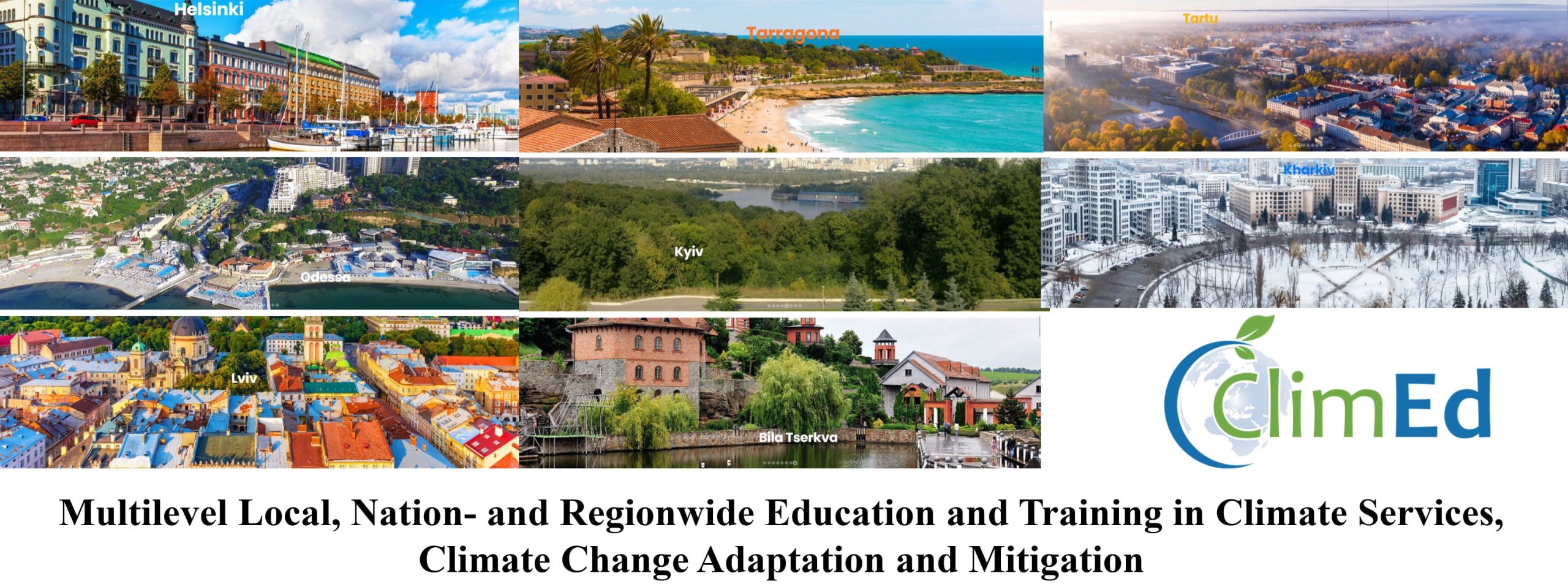
The Erasmus+ ”Multilevel Local, Nation- and Regionwide Education and Training in Climate Services, Climate Change Adaptation and Mitigation” (ClimEd; 2020-2026; climed.network) project was carried out by consortium of Partners: 3 European Universities – the University of Helsinki (UH, Finland; the coordinator), Universitat Rovira i Virgili (URV, Spain), Estonian University of Life Science (EULS, Estonia); and 6 Ukrainian Universities – Odesa I.I. Mechnikov National University, Kyiv National University of Construction and Architecture, O.M. Beketov National University of Urban Economy in Kharkiv, Lviv Polytechnic National University, Bila Tserkva National Agrarian University, Odessa National Medical University; and 2 Ukrainian Ministries – the Ministry of Education and Science, and the Ministry of Environmental Protection and Natural Resources.
Background: Climate change poses growing risks to Ukraine’s environmental, social and economic resilience, while education and capacity to develop and use climate services remained limited. Universities, hydrometeorological institutions, public authorities and climate-sensitive sectors lacked competencies, curricula and cooperation needed to transform climate information into decision support. ClimEd addressed these gaps through competency-based, multilevel education aligned with European and World Meteorological Organization (WMO) practices.
ClimEd objectives: (1) Development of competency-based concepts on professional education in the field of climate services and additional education for experts in climate-dependent economic sectors; (2) Development of teaching and methodological materials, elaboration of distance and blended learning courses in order to form methodological support for the continuous and comprehensive training of specialists in the field of climate services; (3) Development of blended learning courses in the field of climate change and adaptation to it for decision-makers, as well as massive open online courses (MOOC) in the same area for experts in climate-dependent economic sectors; (4) Development of MOOCs in the field of climate change and adaptation to it for the broad masses of the population.
Implementation: ClimEd combined needs assessment, staff training, competency-based curriculum development, establishment of the ClimEd Research and Education Platform and Learning Labs, course piloting, quality assurance, stakeholder engagement and dissemination. Activities were delivered online, onsite and in hybrid formats. The consortium adapted schedules, procurement and responsibilities and completed the planned outputs.
Results: ClimEd established a competency-based multilevel system of climate-services education aligned with European and WMO practices. It developed 90 courses and modules across PhD, MSc, professional-development and open-learning formats and trained 380 students and 327 professionals. The project strengthened digital and practical teaching capacity and addressed 6 climate-sensitive sectors. Courses were integrated into partner universities, with arrangements for their continued use and updating.
Innovation: ClimEd key innovative feature was the establishment of a continuous educational pathway encompassing PhD and MSc programmes, professional development programmes, individual courses and modules, and open online learning opportunities. This enabled to address the needs of different target groups, including university students and teachers, researchers, climate-service providers, public authorities, professionals from climate-sensitive sectors and the wider public. Instead of treating climate education as a specialised subject for climatologists alone, the project positioned climate knowledge and climate services as interdisciplinary competencies needed across society and the economy. ClimEd also introduced an innovative combination of general climate education and sector-specific learning pathways. Common courses provided the scientific, methodological and policy foundations of climate change and climate services, while sectoral courses translated this knowledge into the professional contexts of agriculture, water management, energy, construction and architecture, health care, and urban management. This approach helped participants understand not only climate processes, but also how climate information can be applied to risk assessment, planning, adaptation, mitigation and professional decision-making in their respective sectors. ClimEd’s also created as innovative result the ClimEd Research and Education Platform: an integrated ecosystem combining formal education, research, professional communication and practical work with climate data. The platform brings together Moodle courses, video lectures, expert support, collaborative tools, environmental data from ThingsBoard, analytical software, databases, and equipped ClimEd Learning Labs at partner universities. A particularly innovative element is the ClimEd professional social network, developed using the BuddyPress community plugin for WordPress. It connects students, PhD candidates, teachers, researchers, climate-service providers, public authorities, businesses and stakeholders from climate-sensitive sectors. Unlike Moodle, which supports formal learning, the social network enables continuous communication, thematic discussion groups, professional networking, the exchange of materials, and the development of new forms of cooperation after course completion. ClimEd’s innovation lies in integration of individual tools into a single, sustainable capacity-building environment. The platform supports learning, expert interaction, collaborative knowledge creation, work with real-world data, and the development of practical climate-service solutions. By linking education with real data, digital tools and sector-specific applications, project offers a replicable model for modernising climate-services education. Its results strengthen both individual competencies and the institutional capacity of universities and stakeholder organisations to develop, provide and use climate services.
Implemented activities: WP2 on “Development of a Research-and-Education Platform”. The ClimEd Research and Education Platform was finalised and expanded to integrate the project website, Moodle-based Distance Learning Portal, ClimEd professional network, AFFiNE collaborative workspace, climate-data tools, environmental monitoring dashboards and video resources. IT, multimedia equipment adjusting and software was procured, installed and integrated into ClimEd Learning Labs at all 6 Ukrainian partner universities. Bilingual guidance and resource descriptions were developed. By mid-May 2026, the Portal recorded 10475 visitors, 1884 course subscriptions and 90 uploaded courses or course modules. WP3 on “Development of ClimEd Courses” completed the multilevel educational portfolio, including PhD and MSc courses, professional development programmes across 6 sectoral learning pathways, transversal socio-economic and ICT modules, and one comprehensive, integrated MOOC combining the planned thematic content. All curricula, learning materials, and digital resources were finalised and peer reviewed. WP4 on “ClimEd Piloting” included PhD, MSc and professional development programmes piloted in 2025-2026. MSc and PhD courses had 512 enrolments by 380 students, and professional-development courses 434 enrolments by 327 learners, with some completing multiple courses. The MOOC was delivered during May-Jun 2026 as a follow-up exploitation activity; 238 learners enrolled and 74 completed it. The courses were also promoted through other international platforms. WP5 on “Staff Capacity Building” was realised through 3 online and 4 hybrid training events on climate-services course development, technologies of blended/online learning, MOOC development and the sectoral use of climate information, followed by 2 workshops in Ukraine on course standardisation, peer review, implementation and international visibility. ClimEd trainings, in total 7, attended in total 368 (76 onsite) participants, who gained 54 learning outcomes/ skills. WP6 on “Quality Assurance and Control” activities included assessing staff training, evaluating online and offline resources, and analysing project activities through virtuous circles. This was complemented by stage-by-stage quality control, Advisory Board input, stakeholder validation, and verification that ClimEd courses had been integrated into the academic systems of partner universities. WP7 on “ClimEd Dissemination and Exploitation”. Dissemination included maintaining the website, social media, partner webpages; publishing educational videos, updated promotional materials, e-brochure and two newsletters; presenting results at national and international conferences, seminars and workshops. Exploitation strategy was developed. ClimEd courses were uploaded to the Distance Learning Portal and prepared for wider use through international educational platforms, including the Ukrainian-German Digital Teaching Network.
Involvement: Students and external stakeholders contributed mainly to implementation, supported needs assessment, course testing, evaluation and dissemination. This involved 319 sector representatives, 48 climate-service providers, 380 students and 327 professionals. Their feedback informed course content, learning outcomes, assessment, accessibility and practical relevance. Eight surveys generated 408 responses, while Advisory Boards and 35 support letters provided external validation.
Updated courses: ClimEd developed and substantially updated a multilevel portfolio of 48 complete courses, comprising 8 PhD-level courses, 18 MSc-level courses and 22 professional-development and sector-oriented courses. Through the inclusion of general and sector-specific course versions, these courses form 90 unique curricular units covering climate services, climate change adaptation and mitigation, climate policy, climate-risk assessment and applications in agriculture, health care, construction and architecture, energy, city management and water management.
ClimEd WPs: https://climed.network/work-packages ClimEd News: https://climed.network/news ClimEd Trainings: https://climed.network/events/climed-trainings ClimEd Workshops: https://climed.network/events/workshops
Text by: Inna Khomenko, Valeriya Ovcharuk, ONU & Svyatoslav Tyuryakov, Hanna K. Lappalainen, Alexander Mahura, UHEL-INAR