




|
INAR - Institute for Atmospheric and Earth System Research INAR Initiatives Large scale research projects Finnish Center of Excellence Research Infrastructures SMEAR stations International Collaboration IIASA National Collaboration Education Univ. of Helsinki DP in Atmospheric Sci. |
Events
PEEX Conference 2015 & 5th Meeting
- group photo
- participant list
- agenda
- minutes
- press releases Suomi, English, Russian, Chinese
- photos
- venue
4th PEEX Meeting
- group photo
- participant list
- agenda
- minutes
- other
3rd PEEX Meeting
- group photo
- participant list
- agenda
- minutes
- other
2nd PEEX Meeting
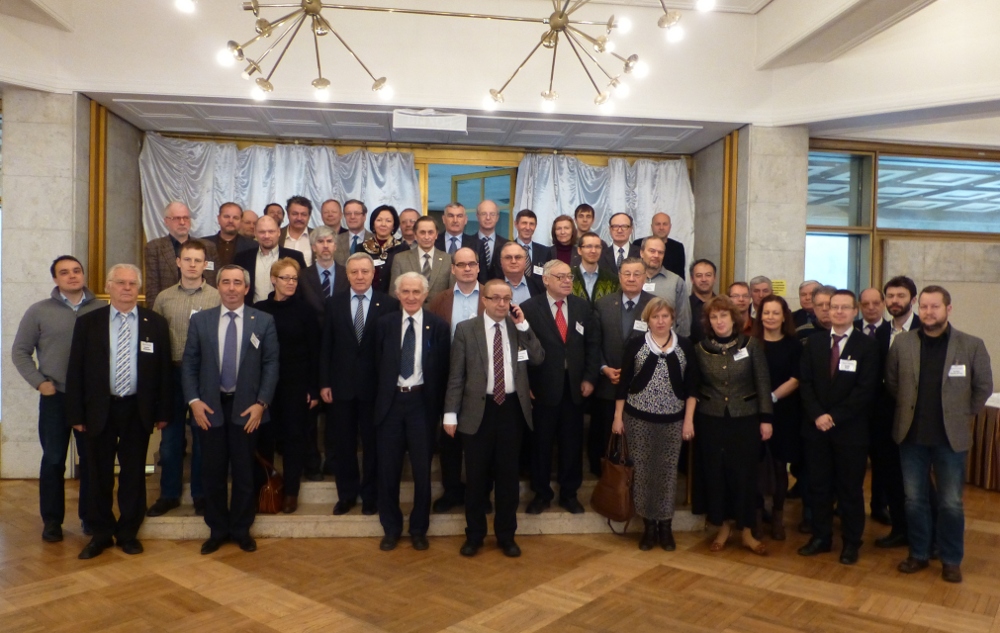
- participant list
- agenda
- minutes
- other
1st PEEX Meeting
- group photo
- participant list
- agenda
- minutes
- other
PEEX China Kick Off Meeting
- group photo
- participant list
- agenda
- minutes
- other
CRAICC – PEEX Workshops 2014-2015
- WS-1 Short-lived climate forcers in the Arctic and Eurasia (Univ.Helsinki Finland)
- WS-2 Carbon exchange in the soil/cryosphere – vegetation - atmosphere continuum (Univ.Helsinki & FMI Finland)
- WS-3 Climate change for Arctic seas and shipping, (DMI Denmark)
- WS-4 Estimating and monitoring anthropogenic emission in the Arctic by using remote sensing, (Nansen Norway)
- WS-5 Climatology of the high-latitude planetary boundary layer (Nansen Norway)
- WS-6 Turbulent exchange across strongly heterogeneous interface ( Univ.Helsinki & FMI Finland)
International Conference & PEEX Sessions
- IGU 2015 – PEEX Session
- EAC 2015 – PEEX Session
- other presentations, posters, abstracts
Projects
- Research and development for integrated meteorology – atmospheric composition multi-scales and – processes modelling for the Pan-Eurasian EXperiment (PEEX) domain for weather, air quality and climate applications (Enviro-PEEX(Plus) on ECMWF, 2021-2023)
- Multilevel Local, Nation- and Regionwide Education and Training in Climate Services, Climate Change Adaptation and Mitigation (ClimEd, 2020-2023; Erasmus+ Programme for Capacity Building in the Field of Higher Education Action)
- PEEX Modelling Platform research and development through HPC-Europa3 Transnational Access Programme (PEEX-MP-Europa3; 2020-2021)
- Pan-Eurasian EXperiment - Academic Challenge (PEEX-AC, 2019-2020; Finnish National Agency for Education; FIRST+ 2019-2020, Finnish-Russian Student and Teacher Mobility Programme)
- Modernization of Doctoral Education in Science and Improvement Teaching Methodologies (MODEST, 2018-2021; Erasmus+ Capacity Building in the Field of Higher Education Program)
- Water Environments and Ecosystem in ice-infested areas under climate change and abrupt weather changes (project description)
- Co-operation between Taiyuan University of Technology (TYUT) and Institute for Atmospheric and Earth System Reseach INAR, University of Helsinki in snow and ice research (project description)
- Co-operation between Northern Water Problems Institute (NWPI) and Institute for Atmospheric and Earth System Reseach INAR, University of Helsinki in hydrology (project description)
- Diagnosis and numerical simulation of the atmospheric boundary layer dynamics and the Arctic terrestrial ecosystems state under anthropogenic stress (project description)
- Physical models of extreme marine weather events caused by climate change in the Arctic zone in the first half of the 21st century (project description)
- Medical-geographical modeling of spatiotemporal changes in the spatial pattern of naturally-dependent and socially important diseases under the changing climate and economic development of the Russian Arctic (project description)
- Pan-Eurasian EXperiment (PEEX) Modelling Platform research and development for online coupled integrated meteorology-chemistry-aerosols feedbacks and interactions in weather, climate and atmospheric composition multi-scale modelling (Enviro-PEEX on ECMWF, 2018-2020)
-
Mechanisms, pathways and patchiness of the Arctic ecosystem responses and adaptation to changing climate (ClimEco, 2018–2020)
-
TRAnsferable Knowledge and Technologies for high-resolution environmental impact assessment and management (TRAKT-2018)
-
Atmospheric Gas-to-Particle conversion (ATM-GTP No 742206 ), 2017-2021 (European Research Council)
-
The Centre of Excellence in Atmospheric Science - From Molecular and Biological processes to The Global Climate (FCoE-ATM), 2017-2019 (Academy of Finland)
-
Horizon 2020, Integrated Arctic Observation System, INTAROS, Grant Agreement No 727890, 2016-2020 (U-Hel partner)
-
Critical steps in understanding land surface – atmosphere interactions: from improved knowledge to socioeconomic solutions (CRUCIAL/ PEEX), 2016-2017 (NORDFORSK)
- PEEX – CRAICC –series of workshops 2014-2015 (NORDFORSK)
- FAAS WS Feb. 2015 (NORDFORSK)
-
AEROCOSMOS- ATM (FCoE), 2014-2016 “Development of methods for monitoring of the dynamics of natural and anthropogenic emissions of trace gases and aerosols in the atmosphere based on satellite data and modelling results” (Bilateral project based national funding instruments)
-
Beautiful Beijing- project, University Of Helsinki (TEKES)
- Finnish Cultural Foundation, Science Workshops on “New approach for Earth System modelling”, 2012-2013, Academy Prof. Markku Kulmala’s international “Earth System modelling” Working Group
- COST Action ES0804: Advancing the Integrated Monitoring of Trace Gas Exchange between Biosphere and Atmosphere (ABBA) + 5 partner Russian projects, 2014-
-
"Air-sea/land interaction: physics and observation of planetary boundary layers and quality of environment”, University of Nizhny Novgorod, Russia, 2011-2015, (Russian Government Mega-Grant 11.G34.31.0048)
-
“Integrated monitoring and forecasting system for local weather and microclimate”, Finnish Meteorological Institute, 2014-2015 (EU Commission: ERC PoC Grant 632295)
-
“Atmosphere-hydrosphere interaction in Baltic Basin and Arctic Seas” 2014-2017 ABBA, Finnish Meteorological Institute (Academy of Finland: Grant 280700)
-
"Atmosphere-hydrosphere interaction in the Baltic Basin and Arctic seas: Satellite remote sensing and modelling of physical processes", Russian State Hydro-meteorological University (Russian Foundation for Basic Research)
-
"Atmosphere-hydrosphere interaction in the Baltic Basin and Arctic seas: Theoretical, laboratory and field studies of the surface waves, drag and heat/mass transfer", Institute of Applied Physics RAS (Russian Foundation for Basic Research)
-
"Atmosphere-hydrosphere interaction in the Baltic Basin and Arctic seas: Satellite monitoring using data from different spectral ranges, restoration of characteristics of the surface waves and of the subsurface layers from satellite images", Research Institute for Aerospace Monitoring AEROCOSMOS (Russian Foundation for Basic Research)
-
"Atmosphere-hydrosphere interaction in the Baltic Basin and Arctic seas: Wind wave measurements, wave hindcast and forecast in present and future climate", Faculty of Geography, Moscow State University (Russian Foundation for Basic Research)
-
"Atmosphere-hydrosphere interaction and boundary-layer phenomena in the Baltic Basin and Arctic Seas: research of a response of the Baltic ecosystems on changes physical and biogeochemical processes in the boundary layers of the sea", Moscow Institute of Physics and Technology – State University (Russian Foundation for Basic Research)
- “Influence of natural and anthropogenic emissions of greenhouse and polluting gases on climate and ecosystem changes in Eurasia”, A.M.Obukhov Institute of Atmospheric Physics RAS (Russia); Max Planck Institute for Biogeochemistry (Germany), Institute of Atmospheric Physics CAS (China), Institute of Acoustics CAS (China), Belorussian State University, 2014-2016 (Russian Scientific Fund (RSF) Project # 14-47-00049)
- "SLICFONIA: complicated study of short-lived climate forcers in the Arctic", A.M. Obukhov Institute of Atmospheric Physics RAS (Russia); P.P. Shirshov Institute of Oceanology RAS (Russia); Norwegian Institute of Air Research (Norway); 2014-2016 (Russian Foundation for Basic Research (RFBR (#14-05-93089) and NRC)
For further information contact PEEX-HQ Helsinki Office
PEEX PROGRAM HEADQUARTERS (HQ), HELSINKI, FINLAND
- Moscow State University, Moscow, Russia
- AEROCOSMOS, Moscow, Russia
- Earth Cryosphere Institute - the separate division of Federal Research Centre Tyumen Scientific Centre of SAB RAS, Tyumen, Russia
- Pacific Geographical Institute of Geography FEB RAS, Vladivostok, Russia
- Institute of Remote Sensing and Digital Earth, CAS (RADI), Beijing, China
- University of Nanjing, Nanjing, China
PEEX PROGRAM GOVERNANCE STRUCTURE (.pdf)
PEEX "Pan-Eurasian Experiment" program is a multidisciplinary climate change, air quality, environment and research infrastructure approach focused on the Northern Eurasian particularly arctic and boreal regions and China. PEEX is an active contributor and a collaborator in the international research and research infrastructure landscape, and also provides a forum for science diplomacy. At an institutional level, the collaboration within PEEX is typically initiated via signing a Memorandum of Understanding (MoU) with the PEEX program (PEEX Partner).
The PEEX science conferences are the main forum for research community to share their scientific outcomes. In addition to organization of the conferences, the active work of the PEEX working groups (WG) is facilitated. Working Groups are community based, bottom up approach with a specific focus. The idea is to provide PEEX services for the PEEX research community, such as information on existing satellite products and in situ data over the Northern Eurasian or carry out case studies. PEEX Working Groups (In situ stations, Satellite, Modelling Platform, Marine Observations and thematic working groups, such as Baikal Selenga Network (BaSeNet) are open to join in.
Coordination of the Program takas places by PEEX offices. The PEEX Headquarter (PEEX-HQ) located in Helsinki, Finland at the University of Helsinki, Institute for Atmospheric and Earth System Research (INAR). PEEX-Helsinki office coordinates the program governance and the communications activities in collaboration with other PEEX offices under the guidance of the Program Steering Committee and collaboration with nominated PEEX Fellows. Current PEEX offices are located in Moscow, Russia; St. Petersburg, Russia; Nanjing, China; and Beijing, China. The main office in Russia is hosted by the Moscow State University together with AEROCOSMOS (remote sensing). The main office in China is hosted by Institute of Remote Sensing and Digital Earth (RADI) (CAS). The office network is expected to expand and new offices will be established based on agreement with PEEX-HQ in Helsinki after the new office candidate has signed the PEEX MoU and has joint the PEEX collaboration network as an PEEX collaborating institute. The PEEX office typically has named science officers, who will be working as a local contact points and passes information within the office network. The idea is that each PEEX MoU partner would has at least one contact person.
PEEX-HQ and PEEX offices in Russia and China will prepare a joint working plan on the following tasks or topics:
- to participate the PEEX communication-outreach activities and provide material such as articles, announcements of opportunity or meetings / conferences, reports on collaborative projects or research outcomes and results or any other item that may be of general interest to the PEEX research community. This work is facilitated by different tools such as websites (www.atm.helsinki.fi/peex/ and/or local website), www-e-news, PEEX newsletters (4 issues per year), e-mailing lists and regular skype meetings to guarantee continuous communication.
- to contribute the planning, development and coordination of the PEEX research infrastructure such as the PEEX in situ observation network
- to participate the planning and hosting of PEEX education such as organizing joint education events (winter / summer schools) and courses for the university students and other relevant groups, bring the local touch to the PEEX education and support in communications such as English – Russia – Chinese translations.
- to search for new possibilities for scientific cooperation, liaising with the parent programs and the host institution as well as with any other relevant national or international bodies or supporting partners.
- to expanding PEEX contact network in local area
- to look for Call-For-Proposals by different funding agencies, proposals, projects, activities, etc. where local partners can be also funded
- to participate in educational activities such as linking and bridging local MSc, PhD programmes to the larger PEEX education network
- to participate in the organization of conferences, conference sessions, meetings and forums of PEEX Science Conferences
- to distribute information in local language to local communities such as translate PEEX web pages from English to Chine/Russia
- to support PEEX Program in it’s task to increase public awareness of Grand Challenges such as climate change and air quality, distribute the new scientific knowledge, results and data products to scientific communities and the public sector, and distirbute tools, scenarios and assessments for policy makers and authorities
Program
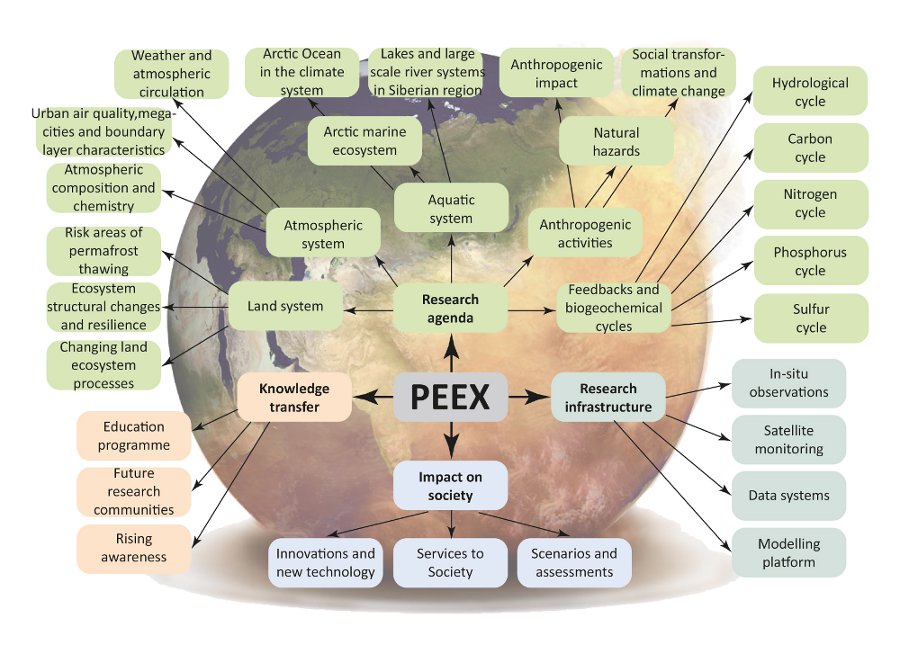
The PEEX program agenda is divided into four focus areas: 1. Research agenda, 2. Infrastructures, 3. Impact on society and 4. Knowledge Transfer (PEEX Science Plan).